Saturday, October 13, 2012

India News: Recovery


Hindustan Times
New Delhi, October 12, 2012
First Published: 21:06 IST(12/10/2012)
Last Updated: 21:15 IST(12/10/2012)
share more.
0 Comments     
There are early signs of a turnaround in industrial activity. Factory output grew 2.7% in August, which is head and shoulders above the 0.4% rate for April-August 2012. Industrial production actually shrank in three of the past five months and the August uptick could be a precursor to the busy season. But it is a long climb out of the trough; the index of industrial production was up 3.4% in August 2011 and 5.6% in April-August last year. Capital goods, a proxy for investments in plants and machinery that build capacities for the future, continued to contract in August — by 1.7%. The cumulative decline over the five-month period is 13.7% after having grown 7.3% a year ago. The combination of tight money and loose government spending that tends to crowd out productive investments in the rest of the economy is still stalking the shopfloor.
Demand for consumer goods is picking up though, which gives the government confidence that the worst may be behind us in manufacturing. Demand for durables in August grew 4%, not far behind last year’s 5.5% and over April-August this segment accelerated to 5.7% from 4.5%. Overall, consumer goods is still trailing last year’s growth but the gap is closing. More than half the industry groups that go into making the index are chugging along reasonably, as are mining and electricity generation. Power output, which has a 10% weight in the index, has grown 4.8% in April-August despite severe coal shortages and overdrawing by states that led to a nationwide grid collapse in July.
The economy may have bottomed out in the first three months of 2012 when the gross domestic product grew 5.3%, the slowest pace during the UPA’s second term. Since then the graph has turned — GDP growth in April-June inched up to 5.5% — and finance minister P Chidambaram hopes the government’s recent efforts to raise the savings rate through a flurry of reforms will turn the country’s investment climate around. The International Monetary Fund, too, expects India’s growth to plunge to 4.9% this year before climbing back to 6% in 2013. Banks have started lowering loan rates, which could be another point of inflection in the Reserve Bank of India’s (RBI) interest rate cycle. The RBI is waiting for inflation to ease before it unwinds its monetary stance and investors have been clamouring for a rate cut. Analysts have begun to see the green shoots of recovery in India’s economic prospects. The factory output data for August ought to bolster their confidence.

Thursday, October 11, 2012

High-energy Vegetarian Foods


Five healthy high-energy vegetarian foods


Last updated on: October 2, 2012 10:26 IST

Yoghurt

Courtesy Gud2Eat.com 
You can steer clear of meat and still boost your energy levels considerably.
In the following pages we bring you five foods to snack on when you're in need of sustenance between meals.

Yoghurt

Did you know that a cup of yogurt is digested quicker by the body than many solid foods giving you a quick protein and carbohydrate energy boost?
Note that carbohydrates get digested faster than proteins.

Image: Yoghurt
Photographs: Courtesy Gud2Eat.com

Whole grains

Last updated on: October 2, 2012 10:26 IST

Whole grains

Snack made up of whole grain breads, cereals (fibre-rich), pasta (whole wheat), brown rice and oatmeal are excellent for delivering and maintaining high energy -- and also help in weight loss.
Foods that contain proteins and fibre help in stabilising blood sugar levels as they help regulate the speed of digestion by moving food at the right pace through our digestive tract.
Image: Whole grains
Photographs: Courtesy Gud2Eat.com 

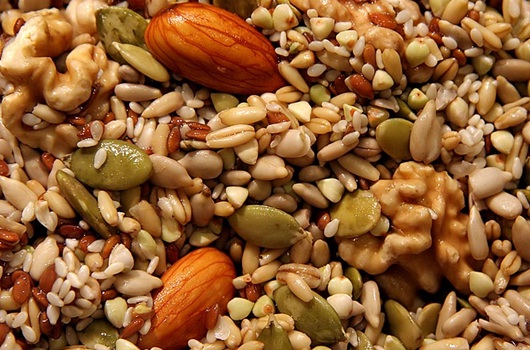
Nuts and seeds

Last updated on: October 2, 2012 10:26 IST

Nuts and seeds

Nuts and seeds are an ideal fatigue fighting snack; the protein in nuts and seeds is converted into lasting energy. Magnesium in pumpkin seeds, almonds and cashews helps fight muscle fatigue. Omega-3 fats in flaxseeds and walnuts are also heart-healthy.
Tryptophan in nuts (cashews, walnuts, almonds) and seeds (sesame, pumpkin) helps battle emotional fatigue and promotes sleep.
Image: Nuts and seeds
Photographs: Courtesy Gud2Eat.com 

Beans

Last updated on: October 2, 2012 10:26 IST

Beans

Beans are rich in complex carbohydrates and a good energy source for the body.
They are also loaded with dietary fibre that helps to control the flow of sugar in the bloodstream and helps maintain a healthy cholesterol level.
Beans have a low glycemic index and are high-energy foods for diabetic individuals too.

Image: Beans
Photographs: Courtesy Gud2Eat.com

Dried fruit

Last updated on: October 2, 2012 10:26 IST

Dried fruit

Dried fruits provide healthy sugars, giving you a quick energy boost.
They are, however, a high-calorie snack so eat only a handful or in limited portions.
Image: Dried fruit
Photographs: Courtesy Gud2Eat.com 
=============================================================================
 

India: Eradication of Corruption.


Old ideas in bold letters

K. SUBRAMANIAN
SHARE  ·   COMMENT   ·   PRINT   ·   T+  
ENDING CORRUPTION? — How to Clean up India: N. Vittal; Penguin Books India, 11, Community Centre, Panchsheel Park, New Delhi-110017. Rs. 499.
N. Vittal has laced familiar themes with nostalgia, anecdotes, homilies and gossip
It is natural that in democracies like ours there is concern over corruption in public life. Efforts have been afoot for years, indeed since Independence, to eradicate the evil. Unfortunately, it seems that they have remained Sisyphean. Truly, corruption is a difficult condition to live with. It eats into our vitals, affects growth and efficiency, and denies justice to the under-privileged.
There have been continuing public discourses on various issues governing corruption. Literature on the subject has grown in volume and value. In India, there is a genuine interest born out of idealism and latterly driven by concerns over growth and social equity. Research institutions and civil society organisations have brought out weighty studies. N. Vittal who made a name for himself as the first Central Vigilance Commissioner (CVC) has contributed a great deal to these debates. His innovative functioning and the stridency shown as the CVC attracted global attention. After retirement he brought out a book, Corruption India, 2003 which was acclaimed by many.
With his erudition and experience as the former CVC and as a member of the civil service, one looks forward to a new book with great expectation. Sadly, the expectations are mostly belied. For those who are familiar with his earlier writings, there is not much that is new in this book. He has reworked the same issues, themes and suggestions and has not brought out any new perspective or analysis to the vexing issues. Rather, he has laced them with some nostalgia, anecdotes, homilies, bureaucratic gossip and Sanskrit slogans!

MEDICAL APPROACH

He adopts a broad schema to study the phenomenon. He proposes what he calls ‘diagnosis’ and adopts the medical approach to “multiple organ failure” and follows the medical analogy or etiology to propose “lines of treatment” to the damaged organs. These organs are: Politics, Bureaucracy, Judiciary, Media and the Corporate Sector. Finally, he proposes “prescription” and involves the citizens and NGOs into the “treatment.” Conceptually, the schema sounds neat and attractive. However, the execution lacks clinical incisions and analytical strength. Along the line, he brings in engineering concepts too and mixes them up. The chapters and themes are not well structured and there is evidence of repetition and the same issues and themes resurfacing in chapters. There are far too many glib and carping generalisations which, if tested holistically, are contradictory. Some of them are unfair or could have been avoided or clothed in more felicitous words.
According to Vittal, “Politics is at the root of the vicious cycle of corruption in our country. Political corruption leads to bureaucratic corruption, which in turn is nurtured by corruption in business.” He proceeds to link politicians with black money via party funding and moves over swiftly to criminal links leading to the emergence of criminals in legislatures as members. Unfortunately, while the syndrome is known, often the middle class intelligentsia, in its moral indignation, mixes up the cause with effect. Who breeds corruption? The people (society) or the politicians? Can we discredit and dispense with politicians and sustain democratic systems?
The simplest of solutions given is that the Election Commission should issue a notification debarring candidates with criminal record from standing for election to legislatures. This is repeated at five or six places in the book. He fails to note that it requires amendment to the Representation of the People Act and proposal for amending the Act has been pending for more than two decades!
He hopes that a system which pays the politicians well may bring about honest politicians. One need not be a cynic, but may well ask, “How much more one should pay?” Vittal is awe-struck by the methods adopted in Singapore and Hong Kong, but fails to reckon with the size of the governments and the nature of the regimes there. Talking about Singapore, the babus may be honest. There are reports about the financial shenanigans of those connected to the ruling family. It is also difficult to go along with the belief that if politicians are honest, down the line, the bureaucracy as a whole will be honest.

NATIONAL POISON

While dealing with the politician-business nexus, the analysis is superficial and does not go deeper into the linkages and the causation. He does refer to the liberalisation process and the proliferation of billionaires in the country. Many economists have analysed the growing cronyism nurtured by liberalisation. However, Vittal throws up his hands saying, “Corruption in the government and the corporate sector may turn out to be the national poison denying India its unique historic opportunity to escape the age-old trap of poverty, inequality and economic backwardness.”
Though the author has been critical of undue delays in the judicial system and how it emboldens the corrupt elements, his suggestions regarding reforms are guarded. He relies more on procedural reforms and computerisation to speed up the process. He seems to rely more on the quality and personality of the judges and their value systems than on restructuring.
In the final analysis, he falls back on four institutions to safeguard the interests of the country: the judiciary, the Election Commission of India, the Comptroller & Auditor General of India and the Central Vigilance Commission. His faith in these institutions is more than fortified by the judgment of the Supreme Court in the case of P.J. Thomas. He goes on to plead for steps to correct the twin deficits of governance — ‘trust deficit’ and ‘ethical deficit.’
He details what he describes as “Prescription to Cure” and turns it into a matter of faith. His idealism is very much to the brim. Elsewhere he says the political class will not commit hara-kiri. How does he expect the same political class to have change of heart when dealing with the appointment of his Pretorian Guards? Vittal puts his faith in the Election Commission to bring it about! How? By debarring them from elections!

Corruption is a complex phenomenon and has its roots deep and wide. It has a long record in our history and culture. It finds new forms and variants. It is imperative that it should be eradicated. The intractability of the problem should not dishearten us and efforts should continue. In that process, this book has some valuable view points and random thoughts. The idealism shown by the author should inform further work on anti-corruption measures.

ENDING CORRUPTION? — How to Clean up India: N. Vittal; Penguin Books India, 11, Community Centre, Panchsheel Park, New Delhi-110017. Rs. 499.

Wednesday, October 10, 2012

Rid our body politic of communal poison


Nadim Asrar
Wednesday, October 10, 2012 at 16 : 55

When your name becomes your worst enemy


0IBNLive IBNLive
A research officer from the prestigious Tata Institute of Social Sciences was recently harassed in Hyderabad while he worked on a report on terror cases across India. Here is an account on the website TwoCircles.net, which is gradually turning into a huge resource for information related to the Indian Muslims. Its reporter Mohd Ismail Khan, who accompanied the TISS researcher Sharib Ali, narrates how he and Ali were picked up by the Hyderabad police after they met a lawyer who was also the president of the Andhra Pradesh Hindu Vahini. The lawyer and the police repeatedly ascribed to their identity - their names - as their legitimate grounds to be suspicious of them and their work.
This is what Sharib had to say on the incident, "This reveals the deepening distrust between communities in the city. As a researcher from a reputed institute, I had gone to meet Mr Reddy in his capacity as a lawyer and I wasn't even aware that he was the President of Hindu Vahini. I had gone there after having discussed the project over the phone and after being invited by the lawyer himself, only to be humiliated later. I have been meeting so many lawyers, but this has never happened before. I was made to feel massively suspect. I am yet to understand why. The only reason that I can think of is that because I am a Muslim. It's quite sad."
Another article on the site tells you that an Indian doctor has been picked up by the Saudi Arab police for alleged terror links. The Saudi police on Monday reportedly arrested Usman Ghani, a doctor working for the National Guard Hospital in Riyadh. On May 13 this year, Fasih Mahmood, an engineer from Darbhanga in Bihar, was picked from his home in al-Jubail, Saudi Arabia in the presence of his wife Nikhat Perween. The Indian government and police agencies initially feigned ignorance about Fasih or his arrest. They admitted to his detention only after a habeas corpus petition was filed by Nikhat in the Supreme Court. Fasih is still in the Saudi custody.
TwoCircles.net is a far cry from any mainstream news portal in India. Since it is run by a few non-resident Muslims, the website can easily be branded as sectarian and even biased - with a heavy-accented sense of victimisation - by the Indian 'mainstream'. However, it does not take away the fact that countless number of Muslims in India continue to face the threat of being branded as suspects in the witch-hunt against terror, thereby perhaps also reinforcing the idea of state terror. It's a war beyond the simple law-outlaw binary. The binary has now acquired modern-vs-anti-modern dimensions, with the majority of Muslims often perceived to be resistant to benign ideas like democracy, secularism and statehood.
The truth is far more complicated than that. That violence and religion together make a potent mix which can influence and even capture state powers is a fact established through history. That every organised religion in the world today has a violent strand is a claim that cannot be easily refuted. So does Islam. But just as the violence valorised by a few Hindutva groups cannot be called a generic Hindu strand, or by the few Zionists in Israel as an essential Jewish strand, similarly the ideology of violence and terror propagated by certain Islamist groups cannot be branded as Islamic. In fact, many violent movements within the Muslim world have hardly anything to do with the spread of Islam, and actually have far more modest aspirations.
Reports like the ones on TwoCircles.net also point towards a deeper crisis. As such arrests and detentions happen across the country, the Indian mainstream media remains remarkably oblivious and indifferent to such accounts. Their silence, erasure and their unquestioned coverage of the state versions make them complicit in the miscarriage of justice being carried out by police and intelligence agencies across India. The legal cornerstone - 'innocent until proven guilty' - is turned on its head. Constitutional guarantees like the habeas corpus and right to fair trial are often denied in such cases, thus pushing those arrested into an abyss where they are tortured, humiliated and often forced to 'admit' their involvement in terror activities.
After the famous Batla House encounter, some teachers of the Jamia Millia Islamia in Delhi came together to form the Jamia Teachers' Solidarity Group (JTSA). The group defines itself as being "committed to the upholding of democratic and human rights, to the safeguard of justice, condemns terrorism of all kinds, including State terror." Recently, JTSA came out with its study titled 'Framed, Damned, Acquitted: Dossiers of a Very Special Cell', which documents 16 cases in which those accused of being operatives of various terrorist organizations (al-Badr, HuJI, Lashkar) and arrested by the Special Cell of Delhi Police were acquitted by the courts. The report is a 200-page document relying solely on the court judgements to bring out the pattern in which the Special Cell operates. Except for a few references in some publications, the report was largely ignored by the mainstream media.
While few can deny the right of the state to defend itself against any threat - real or perceived, no amount of threat can justify a blanket witch-hunt of its own citizens. That the witch-hunt is carried out in the name of the classic Bushism - 'us' versus 'them' - makes it even more sinister. Sixty-five years is a long time for a nation to shed its historical baggage. It is also a long time for constitutional principles like equality, justice and fundamental rights to assume solid foundations. Miscarriage of justice is something that a nation pregnant with superpower-like aspirations can ill afford to exercise.

Rid our body politic of communal poison


OPINION » LEAD

Rid our body politic of communal poison

MARKANDEY KATJU
SHARE  ·   COMMENT   ·   PRINT   ·   T+  
Indians must defeat all those elements that promote and thrive on religious hatred
Though many Hindus and Muslims in India are today infected by the virus of communalism, the fact is that before 1857 there was no communal feeling at all in most Indians. There were, no doubt, some differences between Hindus and Muslims, but there was no animosity. Hindus used to join Muslims in celebrating Eid, Muslims used to join Hindus in celebrating Holi and Diwali, and they lived together like brothers and sisters.
How is it that around 150 years later, suspicion, if not animosity, has developed between the two major religious communities on our subcontinent? Today, Muslims in India find it difficult to get a house on rent from Hindus. When a bomb blast takes place in India the police, incapable of catching the real culprits (because they have no training in scientific investigation), ‘solve’ the crime by arresting half-a-dozen Muslims. Most of them are ultimately found innocent in a court of law, but after spending many years in jail.
This has resulted in tremendous alienation among Muslims in India. In Pakistan, things are even worse for the minorities who often live in a state of terror, scared of extremists and religious bigots.

WATERSHED

1857 is the watershed year in the history of communal relations in India. Before 1857, there was no communal problem, no communal riot. It is true there were differences between Hindus and Muslims, but then there are differences even between two sons or daughters of the same father. Hindus and Muslims lived peacefully, and invariably helped each other in times of difficulty.
No doubt, Muslims who invaded India broke a lot of temples. But their descendants, who became local Muslim rulers, almost all fostered communal harmony. This they did in their own interest, because the vast majority of their subjects were Hindus. They knew that if they broke Hindu temples, there would be turbulence and riots, which no ruler wants. Hence almost all the Muslim rulers in India promoted communal harmony — the Mughals, the Nawabs of Awadh, Murshidabad or Arcot, Tipu Sultan or the Nizam of Hyderabad.
In 1857, the First Indian War of Independence broke out, in which Hindus and Muslims jointly fought against the British. After suppressing the revolt, the British decided that the only way to control India was to divide and rule. Thus, the Secretary of State for India, Sir Charles Wood, in a letter to the Viceroy, Lord Elgin, in 1862 wrote, “We have maintained our power in India by playing off one community against the other and we must continue to do so. Do all you can, therefore, to prevent all having a common feeling.”


DIVIDE AND RULE

In a letter dated January 14, 1887, Secretary of State Viscount Cross wrote to Governor General Dufferin: “This division of religious feeling is greatly to our advantage and I look forward for some good as a result of your Committee of Inquiry on Indian Education and on teaching material.”
George Hamilton, Secretary of State for India wrote to Curzon, the Governor General: “I think the real danger to our rule in India … is the gradual adoption and extension of Western ideas … and if we could break educated Indians into two sections [Hindus and Muslims] … we should, by such a division, strengthen our position against the subtle and continuous attack which the spread of education must make upon our system of government. We should so plan education textbooks that the differences between the two communities are further enhanced.”
Thus, after 1857, a deliberate policy was started of generating hatred between Hindus and Muslims. This was done in a number of ways.
Religious leaders bribed to speak against the other community: The English Collector would secretly call the Panditji, and give him money to speak against Muslims, and similarly he would secretly call the Maulvi and pay him money to speak against Hindus.
History books distorted to generate communal hatred: As already mentioned, it is true that the initial Muslim invaders broke a lot of Hindu temples. However, their descendants (like Akbar, who was the descendant of the invader Babur) who were local Muslims rulers, far from breaking temples, regularly gave grants to Hindu temples, organised Ram Lilas and participated in Holi and Diwali (like the Nawabs of Awadh, Murshidabad and Arcot). This second part of our history, namely, that the descendants of the Muslim invaders, almost all, promoted communal harmony, has been totally suppressed from our history books. Our children are only taught that Mahmud of Ghazni broke the Somnath Temple, but they are not taught that the Mughal emperors, Tipu Sultan, etc., used to give grants to Hindu temples and celebrate Hindu festivals (see online ‘History in the Service of Imperialism’ by B.N. Pande).
Communal riots deliberately instigated: All communal riots began after 1857; there was none before that year. Agent provocateurs deliberately instigated religious hatred in a variety of ways e.g., by playing music before a mosque at prayer time, or breaking Hindu idols.
This poison was systematically injected by the British rulers into our body politic year after year, decade after decade, until it resulted in the Partition of 1947. We still have nefarious elements that promote and thrive on religious hatred.
Whenever a bomb blast takes place, many television news channels start saying that an email or SMS has been received claiming that the Indian Mujahideen, the Jaish-e-Muhammad, or the Harkat-ul-Jihad-al- Islamia has owned responsibility. Now an email or an SMS message can be sent by any mischievous person, but by showing this on TV and the next day in print a subtle impression is created in Hindu minds that all Muslims are terrorists who throw bombs (when the truth is that 99 per cent of all communities are peace loving and good).
During the Babri Masjid-Ram Janmabhoomi agitation, a section of the media (particularly the Hindi print media) became kar sevaks.

PANIC IN BANGALORE

Recently, SMS messages were sent to northeast Indians living in Bangalore and other cities stating that they had killed Muslims in Assam and so they had better get out of Bangalore otherwise they would be massacred. This created panic. When the Muslims of Bangalore came to know of this mischief, they organised a feast for the northeast Indians and told them that someone had played mischief, and that Muslims are not against the people from the northeast.
It is time Indians saw through this nefarious game of certain vested interests. India is a country of great diversity, and so the only path to unity and prosperity is equal respect for all communities and sections of society. This was the path shown by our great Emperor Akbar (who, along with Ashoka, was in my opinion the greatest ruler the world has ever seen), who gave equal respect to all communities (see online my judgment Hinsa Virodhak Sangh Vs. Mirzapur Moti Kuresh Jamat).
When India became independent in 1947, religious passions were inflamed. There must have been tremendous pressure on Pandit Nehru and his colleagues to declare India a Hindu state, since Pakistan had declared itself an Islamic state. It was the greatness of our leaders that they kept a cool head and said India would not be a Hindu state but would be a secular state. That is why, relatively speaking, India is much better off in every way as compared to our neighbour.
Secularism does not mean that one cannot practise one’s religion. Secularism means that religion is a private affair unconnected with the state, which will have no religion. In my opinion, secularism is the only policy which can hold our country together and take it to the path of prosperity.
(Markandey Katju is a retired judge of the Supreme Court and Chairperson of the Press Council of India)

You’ve got (too much) mail

I do not have any non-working hours.
There, I said it. There are just no hours in my day that are totally off-limits to working either for my day job or for the numerous other things I do — including being a volunteer director of a ministry at my church, which at times feels like a full-time job.
I’m not complaining. I love what I do. I’m just stating the obvious for a working mother of three. So, yes, I’ve written e-mails at 3 a.m., although I don’t expect someone to respond immediately. (I’m often surprised when they do.)
Knowing what I know about my work life, I was intrigued by a survey conducted by the Society for Human Resource Management, which found that 21 percent of organizations have a formal policy that limits employees’ use of wireless devices such as cellphones and tablets during non-working hours for work purposes. Twenty-six percent have informal policies limiting their use.
I get why companies are concerned about employees maintaining a balance between work and home life. Overworked and stressed staff can be a problem. But sometimes I work the hours when it’s reasonable for one to be asleep so that I can attend a function at my kid’s school the afternoon or evening before. Or I need to carve out daytime hours to help my husband when he takes his 83-year-old father to a doctor’s appointment.
There are two dynamics at play when it comes to how much our work life bleeds into our personal time. There are people like me who have employment situations that allow them to choose to work long, unusual hours for personal reasons.
And then there are employees who work after hours because that’s the office norm. It’s the culture that has been created by their employer. They know they had better quickly respond to a supervisor’s e-mail even in non-emergency work situations. They know they have to stay connected to stay employed or if they want to move up the corporate ladder.
I had a friend who had taken off to attend a church-related women’s retreat. She had purposely put in extra hours to make sure nothing was left undone during her absence. But her boss kept e-mailing her about a report. She missed most of the retreat e-mailing information. At one point she broke down wiping away tears while tapping furiously on her Blackberry.
I asked readers to weigh in on employers having a communications curfew.
“I would love having the sending and receiving of emails blocked after certain hours,” wrote Bonny from New York. “That doesn’t mean I can’t still write them — they’d be in my outbox, ready to go when I log in next morning. Additionally, I’d have more after hours free time to work on the project I have, without interruptions from email. You know, those PowerPoint presentations, Visio process flows, Access queries, and Excel data analyses that require uninterrupted thinking time, often not achievable during a busy workday.”
Is working on your time off a reflection of your job commitment? One employer thought so.
“I would never hire an employee who isn’t willing to check their emails after work and sometimes work on weekends,” the person said in an e-mail to me. “I was taught to value the importance of a job. Obviously others feel differently. Plus, I am very generous about letting my employees leave for children’s school events, etc. I expect a similar type of loyalty and respect. Workers need to understand that employers need to provide the products and services or there will be no jobs. I have taken significant pay cuts during this recession so as not to lay off employees. The idea that checking their email on weekends isn’t fair is repulsive to me.”
Of the organizations that do not have a formal or informal policy about wireless communication during non-working hours, the majority leave it up to their employees to set their own limits. That’s smart.
People have personal lives and it may become necessary to do things after the formal working hours. In these cases, when possible, responsible employees should be allowed to work off hours to get the job done.
But on the flip side, it’s important to strive for balance so that you aren’t handcuffed to your workplace communication device or always writing e-mails at 3 a.m.
The common sense and ideal situation is for both employers and employees to remain flexible with their time.
Readers can write to Michelle Singletary at The Washington Post, 1150 15th St. NW, Washington, D.C. 20071, or singletarym@washpost.
com. Personal responses may not be possible, and comments or questions may be used in a future column, with the writer’s name, unless otherwise requested. To read previous Color of Money columns, go to postbusiness.com

.

Benefits of Stress


You’re probably stressed out, aren’t you? Don’t worry about it so much. While stress can account for many diseases and other health maladies, it can also be pretty good for you. If you can’t (or won’t) decrease your stress levels, enjoy the benefits that it can bring. There are several.
  1. It makes you stronger.

    If you don’t let it kill you, it can make you stronger. Both mentally and physically, stressing the brain, heart, and muscles forces your body and mind to learn how to heal itself. If strength training in any area of your life is your goal, you won’t be able to it without stress.
  2. You can avoid the flu.

    When you’re stressed out, your body releases cortisol. While it does contribute to belly fat, it’s also an anti-inflammatory. Cortisol releases can help the person working overtime (physically, emotionally, or mentally) to ward off colds and the flu. Although you might feel more worn out, your body could take care of your stressed-out self.
  3. It helps your memory.

    While living in the rat race will probably kill you, you’ll be better able to remember things if you experience stress. Stress can help acutely tune your mental focus for both long and short periods of time. Although chronic stress might give you Alzheimer’s, short bursts of stress can help your memory recall and decision making processes.
  4. It helps you fight — or flight.

    Stress is the body’s way of dealing with the fight or flight response. These responses are increasingly triggered in our interconnected age. And experiencing this stress can be helpful in separating what’s necessary from what isn’t. Is it worth fighting for, or should you simply move on? Stress can help you make your decision.
  5. It gets you “in the zone.”

    Stress helps make it possible for you to get all the things done that you’d rather put off. They say that the ultimate inspiration is the deadline, and they’re right. If you’re stressed about something, you’re more likely to get it done.
  6. It provides a burst of energy.

    A sudden jolt of stress can wake you up and propel you to action on any number of things. Stress releases adrenaline in the body, which helps you perform and maintain resilience throughout the duration of a task.
  7. It helps us evolve.

    Stress, and how we respond to it, has helped humanity adapt and evolve over time. While you don’t want to stress yourself to death, some modicum of stress can help you personally adapt and change to better respond to your current and unique situation. Relax a little. Stress isn’t all that bad!