Monday, August 21, 2017

Meet the bacteria that save babies


A big, successful test “The researchers chose Lactobacillus plantarum after carefully studying its ability to colonise the infant gut over a long period.”   | Photo Credit: Splendens/Getty Images/iStockphoto
MORE-IN

A community-based trial in Odisha finds that administrating synbiotics to newborns can halve sepsis-related deaths

That babies born by Caesarean section are at a slightly higher risk of developing obesity, asthma and other ailments than children born vaginally is now well known. The reason: in a vaginal birth, a baby ingests some of the microbes present in the vagina during the time of delivery. These bacteria colonise the newborn’s gut and keep it healthier when compared with babies born through a C-section.

A low-cost life-saver

However, in the case of India, infants born even vaginally are more prone to infection and sepsis, which causes many deaths. Now, a community-based trial carried out on newborns in rural Odisha has found that administering synbiotics for a week beginning 2-4 days of life could bring about 42% reduction in sepsis.
With 30 per 1,000 live births, the incidence of hospital-based sepsis is huge in India and about a fifth of neonates with sepsis die in the hospital; community-based studies indicate an incidence as high as 17% of all live births. About 30% of sepsis-related deaths occur in the second week, whereas it is around a fifth in the third and fourth weeks, according to a paper in the Journal of Perinatology (December 2016).
There was also a reduction in lower respiratory tract infections such as pneumonia, which was “completely unexpected”. The reduction in respiratory tract infections suggests that synbiotics not only enhanced the gastrointestinal immunity but also overall immunity in the newborns. The week-long treatment costs about $1.

The world of synbiotics

Synbiotics are a combination of probiotic or live microorganisms that provide health benefits and prebiotic which promote growth and sustain colonisation of the probiotic strain. In this case, Lactobacillus plantarum was used as a probiotic. A carbohydrate (fructooligosaccharides) that occurs naturally in plants such as onion, garlic and banana was chosen as the prebiotic. The researchers chose L. plantarum after carefully studying its ability to colonise infant gut over a long period. The bacteria have been shown to protect infants during the early weeks of life. “The bacteria is safe and does not cause problems in sick and even immunocompromised babies,” says Dr. Sailajanandan Parida from the Department of Paediatrics, S.C.B. Medical College, Cuttack, Odisha, and one of the authors of the paper. “The bacteria colonise the gut and do not allow harmful bacteria to grow. They stimulate the immune system so babies are able to produce antibodies against pneumonia and sepsis-causing bacteria.”

‘Overwhelming results’

Researchers from the University of Nebraska Medical Center, U.S. and India studied over 4,550 infants born to mothers from 149 villages in Odisha, where neonatal and infant mortality rates are among the highest in India. The babies were at least 2 kg at birth and had completed at least 35 weeks of gestation. To eliminate any kind of bias in the conduct of the trial, the newborns were randomly assigned to receive either the synbiotics or a dummy. Neither the researchers nor others knew who received what. Half the participants received the synbiotics while the other half received the dummy. The babies were monitored for 60 days, the most critical period when they get sick and die.
The researchers had anticipated only 20% reduction in sepsis but as the reduction was more than twice than what was anticipated, the trial was stopped midway. It is not uncommon for trials to be stopped midway when the results are overwhelmingly positive. Denying newborns the benefits of the synbiotics, which have been found to be beneficial, would be considered unethical if the trial is continued. The results were published a few days ago in the journal Nature.
“The synbiotics can be introduced as a preventive measure for sepsis. It should be given for seven days, 2-3 days after birth,” says Dr. Parida.
prasad.ravindranath@thehindu.co.in

Thursday, July 20, 2017

'Mind-blowing' cows hold clue to beating HIV

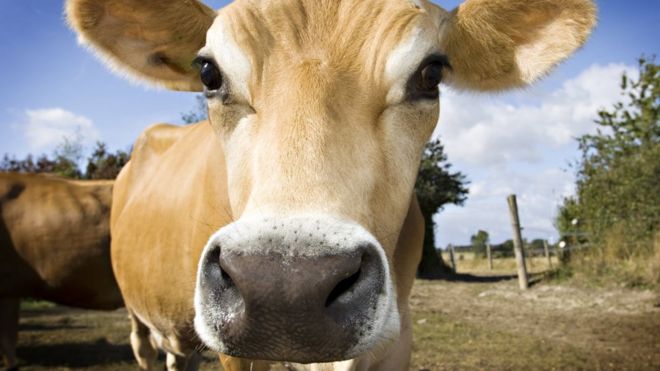
Cow close upImage copyrightGETTY IMAGES
Cows have shown an "insane" and "mind-blowing" ability to tackle HIV which will help develop a vaccine, say US researchers.
In a first for immunisation, the animals rapidly produced special types of antibody that can neutralise HIV.
It is thought cows evolved a supreme immune defence due to their complex and bacteria-packed digestive system.
The US National Institutes of Health said the findings were of "great interest".
HIV is a slippery and nefarious opponent. It mutates so readily that every time a patient's immune system finds a way of attacking the virus, HIV shifts its appearance.
However, a small proportion of patients eventually develop "broadly neutralising antibodies" after years of infection. These attack parts the virus cannot change.
A vaccine that could train the immune system to make broadly neutralising antibodies should help prevent people being infected in the first place.
But no jab can do the job.

Bullseye

Then researchers at the International Aids Vaccine Initiative and the Scripps Research Institute tried immunising cows.
"The response blew our minds," Dr Devin Sok, one of the researchers, told the BBC News website.
The required antibodies were being produced by the cow's immune system in a matter of weeks.
Dr Sok added: "It was just insane how good it looked, in humans it takes three-to-five years to develop the antibodies we're talking about.
"This is really important because we hadn't been able to do it period.
"Who would have thought cow biology was making a significant contribution to HIV."

'Remarkable'

The results, published in the journal Nature, showed the cow's antibodies could neutralise 20% of HIV strains within 42 days.
By 381 days, they could neutralise 96% of strains tested in the lab.
Dr Dennis Burton, a fellow researcher, said: "The potent responses in this study are remarkable.
"Unlike human antibodies, cattle antibodies are more likely to bear unique features and gain an edge over HIV."
Unusually for human antibodies, the broadly neutralising ones have a long and loopy structure. Cow antibodies are inherently more long and loopy.
So the cow immune system finds making the antibodies easily.
It is thought the cow's "ruminant" digestive system which ferments grass in order to digest it is a Wild West of hostile bacteria. So the animals have developed the antibodies needed to keep them in check.
It means cattle could eventually become a source of drugs to make more effective vaginal microbicides to prevent HIV infection.
However, the real goal is to develop a vaccine that encourages the human immune system to make the antibodies it currently finds a struggle.
That remains a significant challenge, but the cattle study could help point the way.
Dr Anthony Fauci, the director of the US National Institute of Allergy and Infectious Diseases, said: "From the early days of the epidemic, we have recognized that HIV is very good at evading immunity, so exceptional immune systems that naturally produce broadly neutralizing antibodies to HIV are of great interest - whether they belong to humans or cattle."

Tuesday, July 11, 2017

Object teleported from Earth to Orbit for the first time

DECCAN CHRONICLE.
PublishedJul 12, 2017, 9:59 am IST
UpdatedJul 12, 2017, 9:59 am IST
The object-in-question is a photon, which travelled from Gobi desert to a satellite called ‘Micius’ orbiting 500 kilometres in total.
‘Micius’ is described to be a highly sensitive photo receiver that is equipped with the ability to detect quantum states of single photons launched from the ground.  (Representational image)
 ‘Micius’ is described to be a highly sensitive photo receiver that is equipped with the ability to detect quantum states of single photons launched from the ground. (Representational image)
Researchers from China have successfully teleported an object from Earth to the Orbit. The object-in-question is a photon, which travelled from Gobi desert to a satellite called ‘Micius’ orbiting five hundred kilometres in total. This is believed to be an important step towards establishing a global-scale quantum internet.
Hooke Professor of Experimental Physics at Oxford University Ian Walmsley tells the World At One how quantum entanglement works and how teleportation could be utilised. He explained that such a deed is achievable through a process called ‘Quantum Entanglement,’ wherein two particles react as one with no physical connection between them.
‘Micius’ is described to be a highly sensitive photoreceiver that is equipped with the ability to detect quantum states of single photons launched from the ground. The aforementioned satellite was developed with the aim to enable scientists to carry out tests that involved quantum entanglement, cryptography and teleportation. “Long-distance teleportation has been recognized as a fundamental element in protocols such as large-scale quantum networks and distributed quantum computation,” says the Chinese team to MIT Technology Review. “Previous teleportation experiments between distant locations were limited to a distance on the order of 100 kilometres, due to photon loss in optical fibres or terrestrial free-space channels.”
At first, the research team created entangled pairs of photons at the rate of 4,000 per second on Earth. Following which, they attempted at teleporting one out of the many pairs of entangled photons to the satellite. Meanwhile, the others remained on Earth. Finally, the researchers measured the photons both on the ground and the orbit and confirmed that teleportation was taking place. “This work establishes the first ground-to-satellite uplink for faithful and ultra-long-distance quantum teleportation, an essential step toward the global-scale quantum internet,” says the team.

Monday, July 10, 2017

This summary is not available. Please click here to view the post.

Anti-gravity treadmill reduces load on knee joints, may boost recovery post surgery

A new anti-gravity treadmill helps to walk or run without the full weight of the body, thus reducing load on knee joints. Experts say it will help people recuperate after knee operations.

FITNESS Updated: Jul 10, 2017 15:44 IST
Knee surgery recovery
The air pressure in the treadmill can be adjusted to take the patient from 100% of their body weight to only 20%, the same feeling as walking on the moon.(Shutterstock)
Using space-age technology, a British scientist has developed an anti-gravity treadmill that can help people reduce their fears of re-injury as well as boost their confidence after knee operations.
The anti-gravity treadmill could provide a great environment for healing and help restore the belief that injured people could make a successful return to any sport they love, said Karen Hambly, senior lecturer at the University of Kent and an international expert on knee rehabilitation.
When people run, the load on their knee joints could be up to five times greater than when walking. Healthy cartilage that covers the bone surfaces in the knee joint transfers these high loads from the lower leg to the upper leg. However, the anti-gravity treadmill can help walking or running without the full weight of the body, while reducing the load on the joints in the lower limbs and bridging the gap between rehabilitation and return to sport, the research showed.

The air pressure in the treadmill could be adjusted to take the patient from 100% of their body weight to only 20%, the same feeling as walking on the moon, and reducing the impact and pressure on joints during the run.
In the study, published in the journal Physical Therapy in Sport, the expert on knee rehabilitation, highlighted the journey of a 39-year-old female endurance runner.
Post her knee surgery, she took an eight-week rehabilitation on the anti-gravity treadmill to take part in her sport again. The anti-gravity treadmill helped in an improved knee and rehabilitation of self-efficacy and subjective knee function.
Follow @htlifeandstyle for more